Correlation & feasibility
Sensor-derived signals compared against gold-standard clinical measures to establish feasibility and relevance.

Digital biomarkers & endpoints
From physiology to function, Delve turns raw wearable signals into validated, regulator-aligned digital measures, so sponsors can trust the data, defend the endpoint, and run it at scale across studies.
Wearable data is noisy, inconsistent, and device-dependent. Digital biomarkers apply validated algorithms, statistical models, and context-aware transformations to turn it into clinical-grade measurements.
A regulator-aligned, stepwise approach to turning raw sensor signals into defensible, submission-ready digital endpoints.
Sensor-derived signals compared against gold-standard clinical measures to establish feasibility and relevance.
Reproducible, device-agnostic algorithms with controlled sampling, normalization, and signal quality checks.
Accuracy, variance, reproducibility, and context-of-use validation aligned to FDA and EMA expectations.
A broad, continuously expanding catalog. Each biomarker is validated for physiological accuracy, sampling reliability, and clinical interpretability.
Heart rate, HRV (RMSSD, SDNN), pulse morphology, and AFib risk indicators.
Respiratory rate, nocturnal RR trends, breath variability, and activity-adjusted burden.
Gait speed, step accuracy, 6MWT digital equivalent, and mobility signatures.
Sleep stages, fragmentation index, circadian stability, and sleep efficiency.
The future of endpoints is hybrid. Delve fuses wearable signals with ePRO triggers, symptom diaries, and clinician assessments into composite endpoints with more explanatory power.

The story behind every datapoint: the human experience inside the physiology.
Real-time HRV and symptom correlation predicted early toxicity signals.
Nocturnal respiratory patterns improved early exacerbation detection.
Gait speed and 6MWT digital equivalents aligned with clinician assessments.
How a signal becomes an endpoint, for teams evaluating digital biomarkers in depth.
Raw signals ingested across devices and sampling rates.
QC rules applied for missingness, artifacts, drift, and outliers.
Algorithms checked against the validation framework and context of use.
Endpoint output versioned, with traceability back to source data.
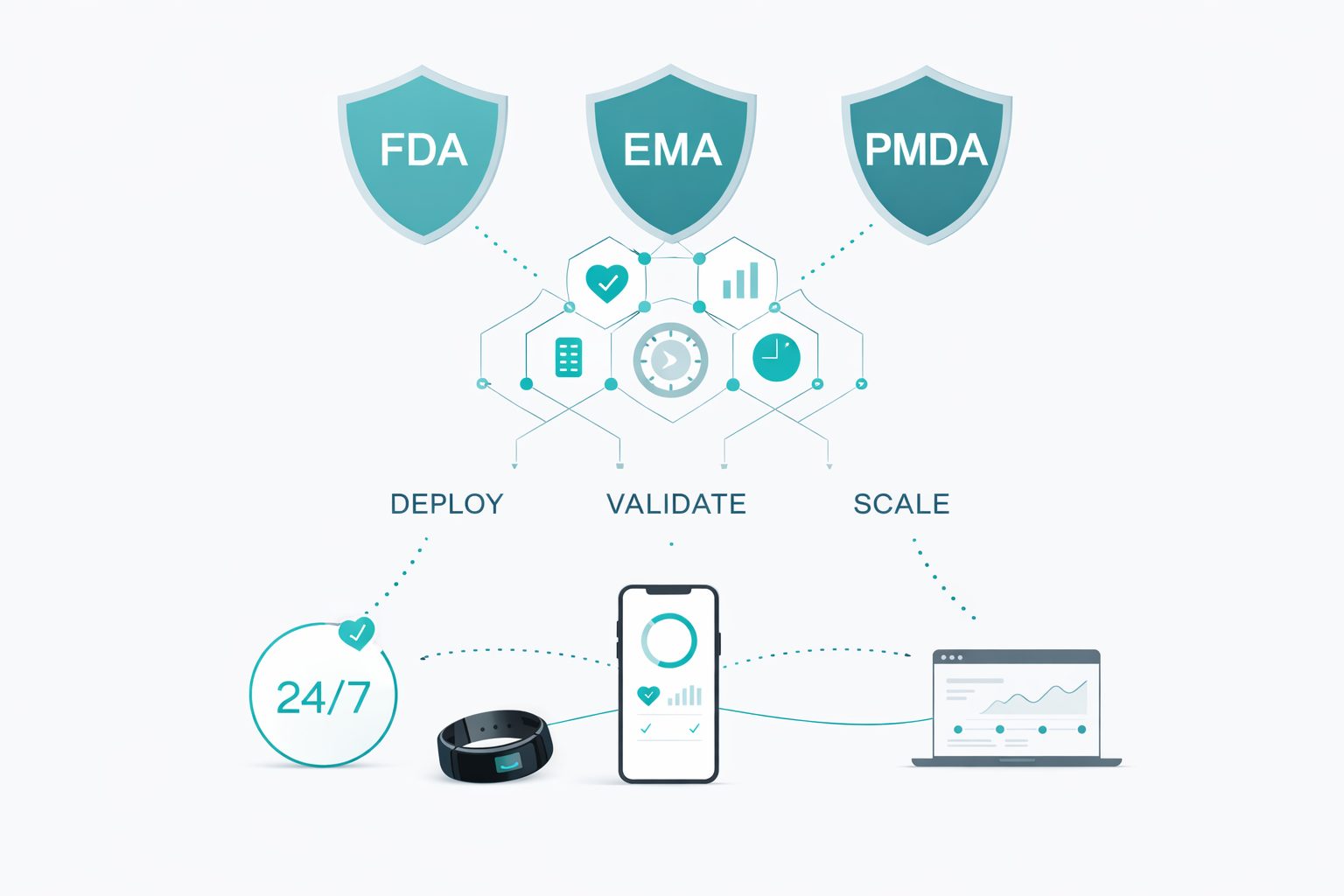
Delve helps sponsors deploy, validate, and scale digital biomarkers aligned with FDA, EMA, and PMDA digital health technology frameworks.
Endpoint definitions aligned to the protocol and applied consistently across studies.
Real-time checks for missingness, outliers, and device drift.
Every endpoint output traceable from raw signal to result.
Definitions, traceability, and reporting ready for oversight and review.
Endpoint design, signal quality, and therapeutic-area applications for digital biomarkers.
How these three categories differ, and why modern trials need all of them working together.
Read →How signal QC protects endpoint integrity before, during, and after data lock.
Read →Continuous cardiac signal capture and the endpoints it makes possible.
Read →How wearables and digital measures change the data picture in CNS studies between visits.
Read →See how validated digital endpoints can accelerate your next study.
Book a demo